GEOTECHNICAL ENGINEERING
HOUSTON
HomeLaboratoryGrain size analysis (sieve + hydrometer)

Grain Size Analysis (Sieve + Hydrometer) in Houston

Evidence-based design. Reliable delivery.

LEARN MORE

Houston’s geology is dominated by the Beaumont Formation—Pleistocene-age clays and silts that dictate how water moves and how foundations perform. The expansive clays in this unit have a plasticity index often exceeding 25, making particle-size distribution a critical parameter before any structural load is applied. A complete grain size analysis, combining mechanical sieving with the hydrometer method per ASTM D422, resolves the full gradation curve from coarse sand down to colloidal clay. This data feeds directly into USCS classification and helps engineers anticipate shrink-swell behavior that costs Harris County property owners millions in foundation repairs annually. For projects near the Buffalo Bayou, where alluvial soils interlayer with older deposits, we often pair the test with a CPT investigation to correlate stratigraphy with laboratory-measured fines content.

In Houston’s Beaumont clays, the difference between a poorly graded sand and an elastic silt is often less than 10% passing the No. 200 sieve—the hydrometer resolves that margin.
Our service areas

Methodology and scope

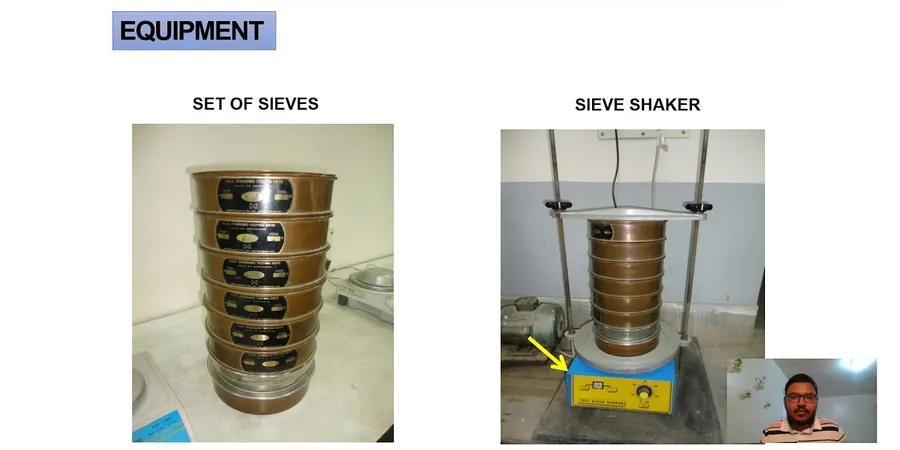
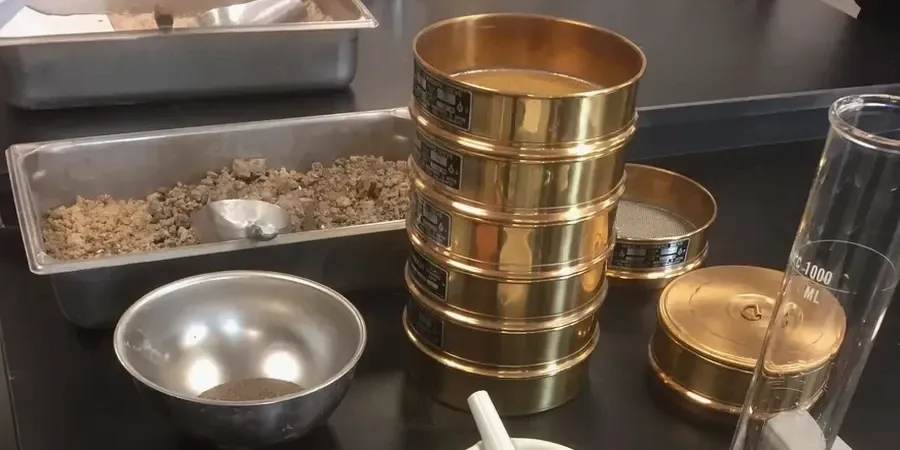
ASTM D422 and AASHTO T-88 govern the dual-procedure approach: a mechanical sieve stack for the sand fraction retained on the No. 200 sieve, followed by a hydrometer sedimentation analysis for the silt and clay passing through. In Houston, where residual soils and filled marsh deposits coexist within a single site, relying solely on a sieve analysis misrepresents the true fine fraction. The hydrometer test quantifies the 0.075 mm to 0.001 mm range, pinpointing the clay percentage that controls drainage and consolidation rate. Our laboratory runs dispersing agents and temperature corrections per ASTM D422-63(2007) to eliminate flocculation errors common in high-plasticity Gulf Coast clays. The resulting grain-size curve integrates directly with Atterberg limits testing to confirm the USCS group symbol, removing ambiguity from borderline ML-CL materials that are widespread across the Houston metro.
Grain Size Analysis (Sieve + Hydrometer) in Houston
Technical reference — Houston

Local considerations

The Pleistocene clays beneath Houston carry a clay fraction that routinely exceeds 30%—the threshold where shrink-swell potential transitions from moderate to high. A grain size analysis that omits the hydrometer step only reports the sand and gravel fraction, leaving the most reactive portion of the soil uncharacterized. We have seen projects in the Energy Corridor where a sieve-only report classified a soil as silty sand, while the full hydrometer curve revealed 45% high-plasticity clay. That misclassification led to slab-on-grade designs with insufficient reinforcement, and cracks appeared within two years. Houston’s seasonal wet-dry cycles amplify this risk: the same clay that passes a No. 200 sieve can expand 10% volumetrically between August drought and May saturation. Without a complete gradation curve, the foundation engineer operates with incomplete data.

Need a geotechnical assessment?

Reply within 24h.

Email: contact@geotechnical-engineering1.org

Explanatory video

Applicable standards

ASTM D422-63(2007), AASHTO T-88, ASTM D2487 (USCS), ASTM D1140 (No. 200 wash)

Technical parameters

ParameterTypical value
Test standardASTM D422 / AASHTO T-88
Sieve range3 in to No. 200 (75 mm – 0.075 mm)
Hydrometer range0.075 mm to 0.001 mm
Sample mass (fine-grained)500 g (dry weight)
Hydrometer typeASTM 152H
Dispersing agentSodium hexametaphosphate solution
ReportingSemilog grain-size curve, Cu, Cc, USCS symbol
Houston-specific sieveNo. 200 wash retained for clay-bound sands

Frequently asked questions

Why does Houston require a hydrometer test when a simple sieve analysis is faster?

Houston’s dominant soil—Beaumont Formation clay—has a very high percentage of fines passing the No. 200 sieve. A sieve-only test stops at 0.075 mm and cannot distinguish between non-plastic silt and high-plasticity clay. The hydrometer method measures particle sizes down to 0.001 mm, giving the engineer the true clay content that controls shrink-swell behavior. Without it, a borderline clayey sand could be misclassified as clean sand, leading to an undersized foundation.

How much does a grain size analysis with hydrometer cost in Houston?

A complete ASTM D422 test including sieve and hydrometer analysis typically runs between US$90 and US$190 per sample, depending on the number of samples and whether additional wash procedures are needed for clay-bound Houston soils.

How long does it take to get results for a grain size test?

The mechanical sieve portion can be completed within one working day. The hydrometer sedimentation phase requires a minimum 24-hour reading period, plus oven-drying and calculations. Standard turnaround for a combined report is three to four business days. Expedited service is available for time-sensitive Houston construction schedules.

What sample size is needed for a combined sieve and hydrometer test?

For fine-grained soils typical of Houston, we require approximately 500 grams of dry material passing the No. 4 sieve. The field sample should be larger—around 2 to 3 kilograms—to account for the coarse fraction removed before the fine analysis. Samples must be sealed in airtight bags immediately after collection to preserve natural moisture content for companion testing.

Location and service area

We serve projects across Houston and its metropolitan area.

View larger map