GEOTECHNICAL ENGINEERING
HOUSTON
HomeSeismicSoil liquefaction analysis

Soil Liquefaction Analysis in Houston: Assessing Seismic Ground Failure Risk

Evidence-based design. Reliable delivery.

LEARN MORE

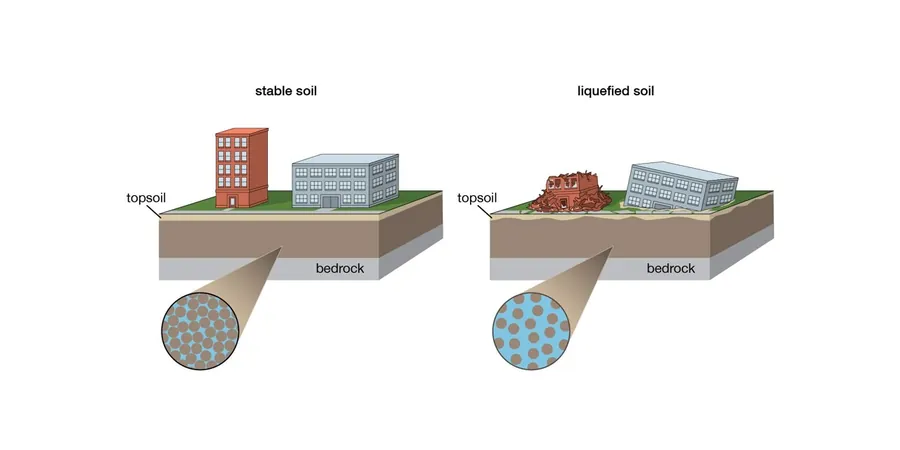
Houston’s flat coastal plain geology hides a complex subsurface reality. Beneath the expansive city, layers of loose, saturated sands deposited by ancient bayous and the meandering Brazos River create conditions where seismic shaking can trigger a sudden loss of soil strength. While the city sits at a moderate distance from major fault lines, deep earthquakes and the soft sediments of the Gulf Coast amplify motion in ways that surprise many developers. Our experience across Harris County shows that even sites mapped as low seismicity need a rigorous soil liquefaction analysis when the water table sits within five feet of grade. The evaluation combines field testing data with laboratory grain-size results to produce a factor of safety that engineers can rely on for foundation design decisions. A site on stiff Beaumont clay near Hobby Airport behaves differently than one on younger Quaternary alluvium along Buffalo Bayou, and that distinction matters.

Liquefaction risk in Houston is governed less by earthquake magnitude and more by the combination of shallow groundwater, young alluvial sands, and site amplification through thick coastal plain sediments.
Our service areas

Methodology and scope

Liquefaction susceptibility in the Houston area varies dramatically between neighborhoods. Sites near the Energy Corridor often encounter point-bar sands with low relative density, while locations closer to The Woodlands sit atop older, overconsolidated deposits that resist pore pressure buildup. The contrast is stark. A standard investigation starts with SPT blow counts corrected for energy and overburden, then moves to fines content verification through grain-size analysis in our accredited laboratory. When a project demands continuous stratigraphic profiles, we deploy CPT testing with a cone penetrometer equipped with a pore pressure transducer, capturing the subtle silty interbeds that can act as drainage paths. The NCEER workshop guidelines remain the backbone of the evaluation, but we calibrate the cyclic stress ratio to site-specific ground motions from the USGS hazard maps rather than relying on generic assumptions. Every report includes a screening for cyclic softening in clays because the transitional Beaumont Formation soils don’t always fit neatly into sand-versus-clay classification boxes.
Soil Liquefaction Analysis in Houston: Assessing Seismic Ground Failure Risk
Technical reference — Houston

Local considerations

The 2023 USGS National Seismic Hazard Model update placed portions of southeast Texas in higher spectral acceleration contours than previous maps. That change caught the attention of structural engineers working on critical facilities in the Houston Ship Channel area, where thick Holocene sands fill buried channels. A profile near the Port of Houston often reveals ten to twenty feet of loose sand with a water table at four feet below grade. Under a design earthquake with a 2,475-year return period, those layers can generate excess pore pressure rapidly because the drainage path is long and the loading rate is fast. What we see most often in this region is not catastrophic flow failure but differential settlement from partial liquefaction, enough to crack slab-on-grade floors and damage buried utilities. The IBC Chapter 18 requirements for seismic site classification make a site-specific liquefaction evaluation mandatory when loose saturated sands are identified in the upper 50 feet, and skipping that step has led to costly retrofits on completed structures.

Need a geotechnical assessment?

Reply within 24h.

Email: contact@geotechnical-engineering1.org

Applicable standards

ASTM D1586-18: Standard Test Method for Standard Penetration Test (SPT) and Split-Barrel Sampling of Soils, ASCE 7-22: Minimum Design Loads and Associated Criteria for Buildings and Other Structures, Chapter 20 Site Classification Procedure, NCEER/NSF Workshop (1997): Summary Report on Evaluation of Liquefaction Resistance of Soils (Youd-Idriss consensus framework), IBC 2021 Section 1803: Geotechnical Investigations requiring liquefaction assessment for Seismic Design Category D, E, and F

Technical parameters

ParameterTypical value
Standard Penetration Test (SPT) N-valuesField data corrected for overburden (N1)60, energy ratio, and rod length per ASTM D1586
Cone Penetration Test (CPT) metricsTip resistance (qc), sleeve friction (fs), and pore pressure ratio (Bq) for soil behavior type classification
Fines Content (FC)Percent passing #200 sieve from wash analysis, critical for CRR correction per NCEER/NSF workshop recommendations
Groundwater depthMeasured in monitoring wells or CPT dissipation tests; typically 3 to 10 ft below grade in Houston area
Peak Ground Acceleration (PGA)Site-specific from USGS Unified Hazard Tool, adjusted for site class via ASCE 7-22 amplification factors
Cyclic Stress Ratio (CSR)Computed per Seed-Idriss (1971) with magnitude scaling factor (MSF) applied
Factor of Safety (FSL)CRR/CSR ratio at each liquefiable layer; FSL < 1.1 triggers mitigation analysis
Post-liquefaction settlementEstimated using Tokimatsu-Seed or Ishihara-Yoshimine methods based on SPT or CPT data

Frequently asked questions

Is liquefaction really a concern in Houston given the low seismicity?

Yes, and it surprises many stakeholders. The combination of shallow groundwater, loose Holocene alluvium, and long-period amplification through thick Gulf Coast sediments means a moderate earthquake on the New Madrid or even a distant subduction event can produce shaking intensities at Houston sites that trigger liquefaction in susceptible layers. The current USGS hazard maps and IBC site classification requirements mandate evaluation when loose saturated sands are present, regardless of perceived regional quiescence.

What's the typical cost range for a soil liquefaction analysis in Houston?

For a standard commercial site evaluation including drilling, SPT sampling, laboratory grain-size testing, and a signed engineering report with factor-of-safety calculations, the cost typically falls between US$2,890 and US$4,570 depending on the number of borings and the depth of investigation required.

What mitigation options do you recommend if liquefaction is identified?

The mitigation strategy depends on the depth and thickness of the liquefiable layer. For shallow zones under light structures, we often specify vibrocompaction or stone columns to densify the soil and provide drainage paths. For deeper deposits or heavy structures, deep foundations such as driven piles that bypass the liquefiable stratum entirely become the preferred solution. Ground improvement with cement grouting can also be effective in silty sands where vibratory methods perform poorly.

Location and service area

We serve projects across Houston and its metropolitan area.

View larger map