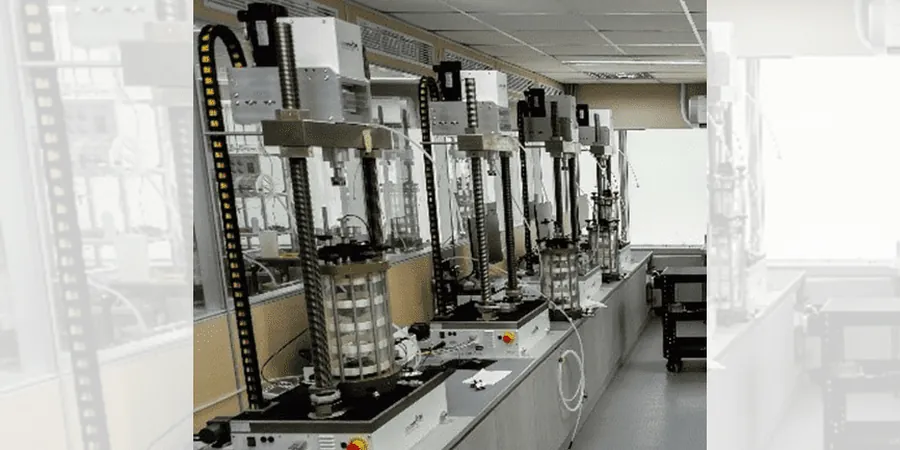
Houston's geotechnical profile is a tale of two formations: the stiff Beaumont clays west of downtown and the younger, compressible deposits tracing Buffalo Bayou's historic floodplain. Designing anything from a Westchase mid-rise to a Ship Channel tank farm without resolving effective friction angle (φ') and cohesion (c') is a gamble. We run consolidated-undrained (CU) and consolidated-drained (CD) triaxial tests to give structural engineers the exact parameters needed for bearing capacity and slope stability models. When a site hits those gray, fat clays at 15 feet, we often pair the triaxial data with a grain-size analysis to confirm fines content, since Houston's Beaumont Formation can swing from sandy lean clay to high-plasticity fat clay within a single boring. The I-10 corridor alone has enough soil variability to make textbook assumptions dangerous.
In Houston's Beaumont Formation, the difference between φ'=26° and φ'=30° can change a retaining wall design from a cantilever to a tieback system. That's the value of a proper triaxial test.